Category: Reflections & Personal Growth

A space for deep introspection, where moments of struggle and triumph reveal their meaning. Here, I explore the journey, the questions that shape us, and the unseen design within every step forward.

  • Anatomy of the Test

    Anatomy of the Test

    I used to think the point of a test was to pass and move on. Now I know the point of a test is to become someone who carries the next one with grace.

    There are three ways God tests you.

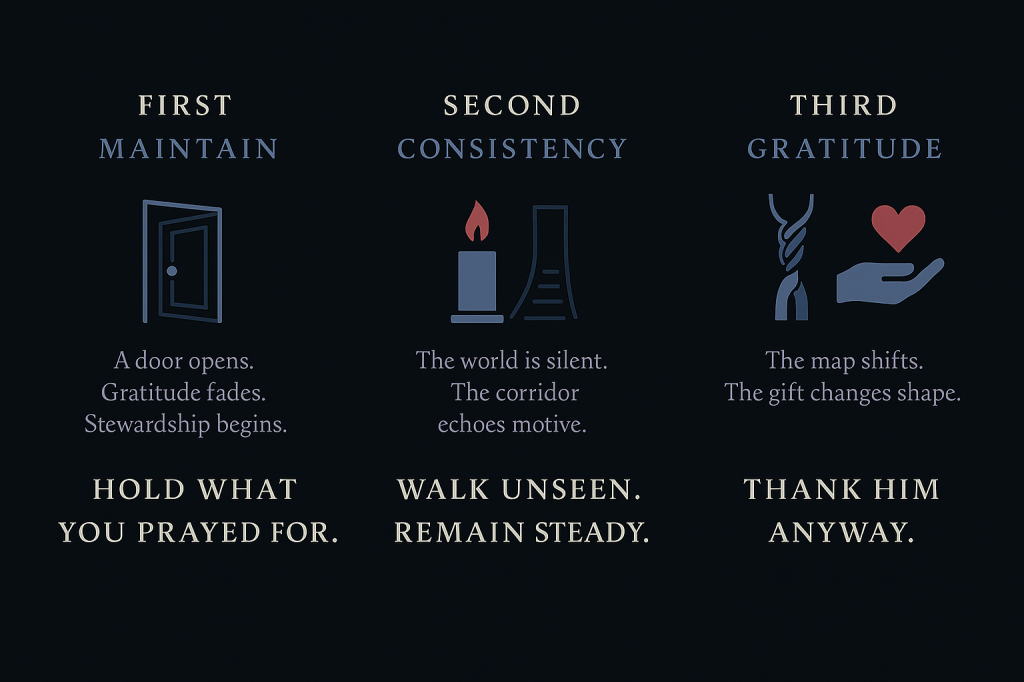
    First, He gives you exactly what you asked for and watches how you hold it. A door opens. A title sits on your chest. The prayer that once lived on your tongue becomes a weight on your shoulders. Gratitude is easy when relief is new. The real exam begins when novelty fades and the work remains. You asked to arrive. Now you are asked to maintain.

    Second, He gives you silence. You study, plan, ask, and the world does not move. This is the corridor where echoes reveal your motives. Were you worshiping an outcome or the One who writes it. This is the test of patience without theatrics. No audience. No applause. Only consistency.

    Third, He gives you something, but not what you wanted. A path appears that was not considered on your map. A position you pictured slips from your hand. A person you imagined becomes a teacher instead of a partner. This is the braid of patience and gratitude together, the most difficult weave. You are asked to thank Him for a gift whose shape you did not choose.

    And all of it is written. Not as a sentence, but as a mercy that knows more than I do. I am where I am for a reason. When I read my days through these three lenses, the pattern begins to show. The gift asks for gratitude. The silence asks for patience. The redirection asks for trust. Even when the mind cannot carry the whole picture, the soul can keep its posture. He arranges the quiet logistics of mercy: a seat left open at the end of a row, a fateful meeting that quietly reroutes the season of your life, a message arriving between two doubts, a corridor taken because another was briefly closed. All of it is written from beyond what we can comprehend. Shift one variable and the crossings shift with it. What departs makes space. What pauses at the threshold becomes shelter. What reaches you by a side street is still arrival. What might have been yields to what was needed.
    I wrote about arrival. About how what I begged for did not feel like relief when it finally came. That dissonance was not punishment. It was the kiln, not the gavel. The heart thinks it wants the summit. What it actually needs is the lungs to breathe up there.

    There is a curriculum to ordinary life if you are willing to enroll.

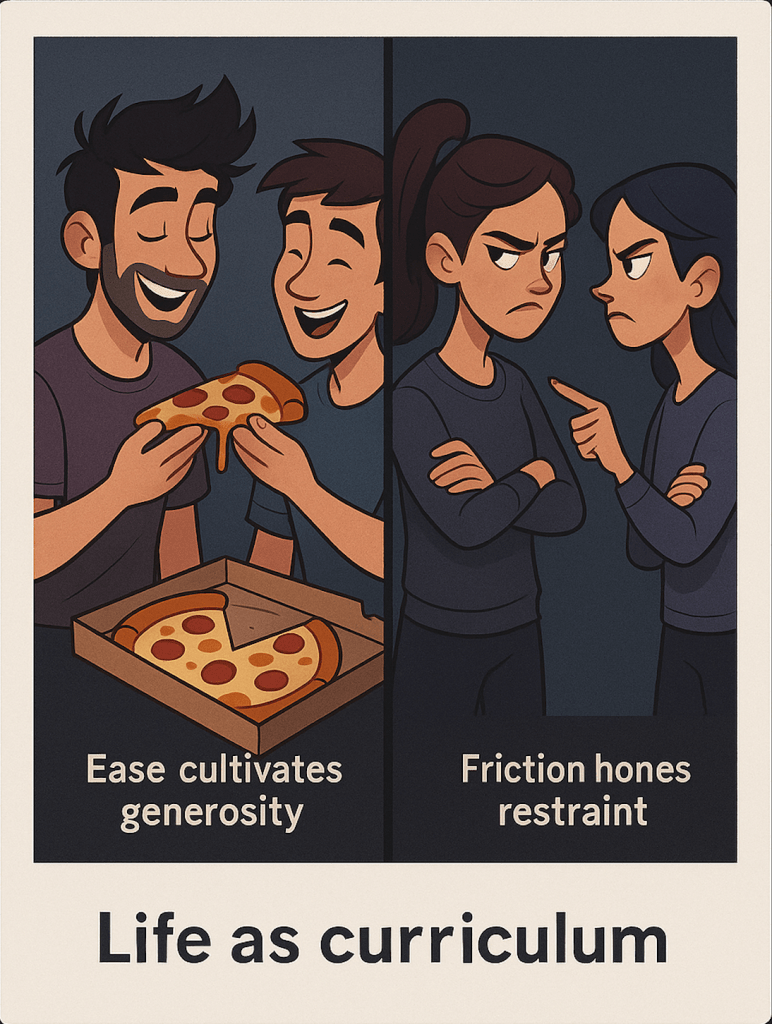
    As I wrote before, a difficult roommate is a class in restraint, boundaries, timing, and the grace of a closed mouth. A generous roommate is a class in receiving without guilt and giving without ledger. Both are mercy, written in different ink. The same pattern repeats everywhere. In friendships that do not ripen on your timeline. In positions that arrive later than you hoped. In open doors that lead to long hallways before the next door appears.
    To reiterate what I said before, we are all students, of medicine and of one another. If you refuse to bring ease to a household because you are busy, remember that we all are. Everyone is carrying deadlines, exhaustion, private storms. The deeper test is to care anyway. Choose empathy when apathy is easier. You can feel at one hundred and still climb down to lift someone from the gutter. Study tempts you to hoard your energy. The truer measure of a physician is not how much he memorizes. It is how deeply he can still feel when everything else in him is tired. The selfishness of others once tempted me to mirror it. In that mirror I found my answer: keep my character. Serve in quiet. Give without praise. That is where the heart of a doctor begins to glow, in conversation, understanding, and service. And yes, the body concurs. Care releases oxytocin. In plain words, it feels good to do good.

    Sometimes a lesson moves with clinical quiet. It stands near without trespass, measured like a steady sinus rhythm. Firm without hardness. Warm without claim. In its cadence I hear systole gather what must be held and diastole return it to space. The brief refractory pause protects timing so no beat is forced. From that rhythm I learn the posture of closeness: a clean gaze, open hands, careful speech, patience between beats, boundaries kept. I keep this nearness as amānah. Gratitude in the closeness. Patience in the spacing. Trust for a rhythm I did not compose. It teaches by being as it is, and by being so, it points to the One who arranges every interval.

    وَلَقَدْ خَلَقْنَا الإِنسَانَ وَنَعْلَمُ مَا تُوَسْوِسُ بِهِ نَفْسُهُ وَنَحْنُ أَقْرَبُ إِلَيْهِ مِنْ حَبْلِ الْوَرِيدِ

    “We created man and know what his soul whispers, and We are closer to him than his jugular vein.” (Qāf 50:16)

    If He is nearer than the jugular, then any nearness between us is custody and a protection from ourselves. I learn to mirror that mercy. Close without crossing. Steady without pressure. Gratitude when the pulse draws near, patience when the rhythm asks for space, trust because the heart has an Owner before it has an admirer. To love like this is to keep the amānah and leave freedom intact, so what lives between us can keep its right pace. This is the lesson I intend to live. Tenderness with boundaries. Service without proof. Reverence without possession.

    وَلَنَبْلُوَنَّكُمْ بِشَيْءٍ مِّنَ الْخَوْفِ وَالْجُوعِ وَنَقْصٍ مِّنَ الأَمْوَالِ وَالأَنفُسِ وَالثَّمَرَاتِ ۗ وَبَشِّرِ الصَّابِرِينَ

    “We will certainly test you with something of fear and hunger and loss of wealth, lives, and fruits, but give glad tidings to the patient.” (Al-Baqarah 2:155)

    لَئِن شَكَرْتُمْ لَأَزِيدَنَّكُمْ

    “If you are grateful, I will surely increase you.” (Ibrāhīm 14:7)

    Between these two ayat sits the shape of a life. Patience holds you steady when the ground shifts. Gratitude turns whatever remains into seed.

    I used to chase certainty. Now I keep the covenant where only God sees. I strive for the work no one tallies and the good no one posts. I show up when I am tired and when I am quiet. Study with focus. Pray with presence. Cook generously for others and feed my own body simply, so I can care for people with grace. Rest without guilt so I can be gentle. Call home. Shoulder a piece of someone else’s load. Leave rooms lighter than I found them. Guard the tongue. Give the benefit of the doubt. Repeat. Everyone is busy. I intend to be busy with what makes me useful.

    There are days the spirit feels threadbare. There are nights the prayer is a whisper you are not sure reached the ceiling. Growth rarely announces itself. It behaves like tissue. Tear, repair, repeat. It behaves like memory. Forget, recall, repeat. It behaves like love. Give, rest, give again.

    There is a different kind of happiness available when you stop demanding that life prove itself. It is quieter, but it holds. It comes when you accept that longing will always live here. Longing for mastery. Longing for companionship. Longing for the kind of impact that outlives a semester. None of that disappears when you cross a threshold. But longing can be harnessed. It can be yoked to service. It can be trained to bow.

    So here is the working map.

    If He gives you what you asked for, practice gratitude that fixes your posture when the weight sets in.

    If He gives you silence, practice patience that keeps your hands moving when results do not.

    If He gives you something else, practice trust until your thanks catches up to your understanding.

    Arrival is not relief. Arrival is responsibility. It is the privilege of carrying what you asked for without breaking the promise you made while you were asking. It is walking back into the same storm with a different posture. Head bowed in humility. Eyes lifted in trust.

    I do not know how long this weather lasts. I do know who I want to be while it passes. Someone who holds longing without letting it hollow him out. Someone who studies the body and remembers the soul. Someone who recognizes khair when it comes dressed like inconvenience. Someone who keeps a lamp within, so whether the room is crowded or still, there is light to share.
  • The Anatomy of Arrival

    The Anatomy of Arrival

    The first week of medical school did not feel like a beginning. It felt like stepping back into the storm I once begged to escape, only this time the storm bore my name. The calendar said I had arrived. My badge said I belonged. My body said otherwise. Between lectures, labs, and a mind that kept sprinting when it should have walked, I realized the myth I had carried for years: once I got here, I would finally be happy. As if joy were a door that only opens when a single number appears on a screen or a single acceptance email lands in an inbox.

    Life did not bend to that story. It never does. It turns out the meaning of life is rarely found in the fireworks at the edge of a finish line. It lives in the intervals. It hides in the ache between efforts, in the quiet after a long night, in the small, steady acts that nobody claps for. I used to believe happiness sits just ahead of me, a reward waiting for a future version of me who has finally earned it. Then another test appears. Another hill rises. The target shifts, and I start waiting again. Waiting, then waning. Highs flare and fade. Lows teach and pass. The heart thinks it is chasing certainty, but really it is learning endurance.

    I used to name this feeling lack. Now I am learning to call it becoming — that subtle, sacred work of being shaped while I’m too distracted to notice it happening.

    Arrivals often disappoint because we mistake thresholds for destinations. You can cross a threshold and still be the same person who walked up to it. That is why repetition matters. The discipline of showing up recalibrates the soul. Anatomy readings, histology slides, a thousand questions that do not care about how poetic I feel today. Faith teaches the same lesson through different means. Stand. Bow. Prostrate. Repeat. Not to perform, but to be reshaped by the pattern. Cellular life follows its own rehearsal. Division, fatigue, repair. Mitochondria hum. DNA uncoils and recoils. Scar tissue forms where damage once lived. The body remembers, and then it builds.

    Meaning sits in that choreography. Growth looks ordinary from the outside. Inside, it is fierce.

    This year has already asked me to make peace with what might have been. The phrase haunts me, not as regret, but as an unlit hallway I keep turning toward. What might have been if the last exam had gone differently. What might have been if certain doors had opened earlier. What might have been if I had met certain people in a different season. I hold that question up to the light and I see its twin: what happened in its stead. A roommate I did not choose. A conversation I did not plan. A network that slowly, almost stubbornly, became a kind of shelter.

    And maybe that’s how God teaches us. Through the quiet, the mundane, the daily mirrors. A few weeks ago, I gave a khatirah at the mosque here in Grenada, scratching only the surface of what my studies have been showing me: that medicine and meaning move in parallel lines. Both demand observation, patience, and humility.

    And so, God can test you with a bad roommate or a good one. Both are curriculum. A difficult one teaches you spine, patience, boundaries, and the grace to hold your tongue. A generous one teaches you to receive ease without guilt and to offer ease back without keeping score. Both are lessons. Both are mercy, just written in different ink. The ease and belonging I feel right now did not descend from the sky. They grew out of unlikely arrangements, the kind that make you admit that khair often travels the back roads while you are staring at the highway.

    We are all students — of medicine, of patience, of one another. If you refuse to bring ease to a household because you are busy, remember that we all are. Everyone’s fighting their own deadlines, their own exhaustion, their own mind. Yet it’s within that exhaustion that the real test lies: to care anyway. To choose empathy when apathy is easier. It’s the same with relationships. You can feel 100% while the other is in the gutter, like I am whilst writing this, and still choose to show up. Medical school tempts you to hoard your energy. But the true measure of a physician isn’t how much they memorize, it’s how deeply they can still feel when everything else in them is tired. The selfishness of others once tempted me to be selfish in return. In that mirror, I found my answer: to continue being myself. To keep serving, even through silence, even through unappreciated effort. That, I think, is where the heart of a doctor begins to glow — through the act of conversation, understanding, and service. And besides, science backs it up: caring releases oxytocin. In other words, it feels good.

    I am learning to narrate my own life with more humility. Maybe the question is not “Am I finally happy now that I have arrived,” but “Can I be faithful inside the waiting.” Waiting does not mean passivity. It means practicing presence while the outcome stays hidden. It means learning to live inside a day without mortgaging it to a fantasy of permanent ease. It means training the heart to stop bargaining with the future.

    The old me measured progress by milestones. The new me is learning to measure it by maintenance — by learning to show up, study, pray, cook as a treat for myself, sleep, call home, and keep doing so with gentleness instead of pressure. The task is not to escape the cycle but to sanctify it. The Prophet’s tradition is a rhythm of small consistent deeds. Biology agrees. Small signals, repeated enough, change expression. Genes turn on and off. Tissues adapt. What the heart rehearses, it becomes.

    There is a different kind of happiness available when you stop demanding that life prove itself. It is quieter, but it holds. It comes when you accept that longing will always live here. Longing for mastery. Longing for companionship. Longing for impact that lasts longer than a semester. None of that disappears when you cross a threshold. But longing can be harnessed. It can be yoked to service. It can be trained to bow.

    I think of Ramadan again, the heat, the fatigue, the prayers that felt like whispers lost in a big sky. I think of suhoor in the dark and the taste of water at iftar. Spiritual growth rarely announces itself with trumpets. It grows the way muscle grows. Tear, repair, repeat. It grows the way memory grows. Recall, forget, recall again. It grows the way faith grows. Ask, wait, receive, then keep asking because receiving is not the end.

    So here is my working definition of arrival. Arrival is not relief. Arrival is responsibility. Arrival is the privilege of carrying what you asked for without breaking the promise you made while you were asking. It is walking into the same storm with a different posture. You bow your head in humility, but you lift your eyes in trust. There are dually innervated answers here: the only real asset a human has is his promises — the ability to make them, to keep them, to stand by the oath of arrival even when the weight of it begins to press down.

    I do not know how long this storm will last. I do not know what the next threshold will cost. I do know what I want to become while I walk toward it. Someone who holds his longing without letting it hollow him out. Someone who studies the body and remembers the soul. Someone who recognizes khair when it arrives dressed like inconvenience. Someone who learns to say thank You for the good roommate and the difficult one, because both teach me how to build a home inside myself. And oh, how hollowing it is, to see the lesson past the what-might-have-been and into what has been given instead, whether through a good roommate, a bad one, or the roommates of my own heart, brain, and soul.

    O Allah, write for me a heart that is steady in the waiting. Teach me to carry what I asked You for with grace. Let my work be worship and my worship be light. Make the unseen khair clear when I am too tired to notice it. Allow me to belong first to You, so that I can belong gently to others. And when the next threshold comes, let me step through it with a soul that remembers why it had to hurt first.

  • Threads of Serendipity, Veins of Trial

    Threads of Serendipity, Veins of Trial

    The Trial Looms

    The air hums with a sterile buzz, a relentless drone that burrows into my temples and presses against my skull like a tightening vice. Overhead, fluorescent lights glare down — unblinking, merciless — casting the testing center’s halls in a cold, clinical sheen that feels more like an interrogation chamber than a place of learning. I’m 24 hours from a reckoning, a crucible not of fire or steel but of paper and pixels, a tempest of questions poised to carve my worth into the unforgiving stone of a numerical score. My chest constricts, each breath a shallow, ragged plea; the world narrows to a pinprick, a fragile pulse thudding in my ears. If I had to gauge my confidence, it’d flicker at a brittle 10%, a lone candle trembling in a gale, threatening to gutter out with the slightest gust.

    I pace these alien corridors, my sneakers scuffing against the polished tile, searching for a shadowed nook to anchor myself. My backpack sags with the weight of water bottles, crumpled notes, and a red covered MCAT prep book, its pages worn down. I mutter duaas under my breath, O Allah, steady my heart, sharpen my mind, their rhythm a lifeline as I cram one last equation, one last pathway, into a brain already teetering on overload. The stakes loom like a mountain: years of study, late nights, and quiet dreams distilled into this single, suffocating moment. I’m not just a student here; I’m a soul laid bare, wrestling with the dread that I might not be enough.

    To grasp the weight of this trial, I must pull you back with me — back to the stillness of a month ago, when Ramadan unfurled its sacred tide across my days. In my last blog post, I wrote of its dawn, how it arrived like a whisper on the wind, calling me to rise before the sun for suhoor, to break my fast at iftar with dates and the chatter of family. It was a month of hollowed hunger and brimming hope, each day a canvas stretched taut between discipline and devotion. The fast stripped me down, peeling away the noise of the world until I could hear my own heartbeat, steady and searching, beneath the silence.

    The Nights of Power — Laylat al-Qadr — glowed on the horizon like stars breaking through a storm. I chased them in the small hours, standing alone in my room as the world slept, the carpet cool beneath my feet, my voice a fragile thread weaving through the dark:

    • O Allah, turn my solitude into a sanctuary, my fear into trust.
    • Grant me the strength to stand beneath the sun, the patience to wait for the unseen.
    • Shape me into a lantern of Your light, not merely a shadow chasing it.

    Those nights crackled with an electric hush, a vastness that swallowed me whole and left me trembling with awe. Ramadan was a forge, its heat searing away my doubts, its rhythm hammering resilience into my bones. I emerged from it lighter yet stronger, carrying lessons that lingered like a quiet hum beneath my skin: that worth isn’t measured by what I achieve, but by how I endure; that surrender can be a form of power. As the month faded, I turned my gaze forward, toward the MCAT — a storm I’d known was brewing, a trial that would test not just my knowledge, but the spirit Ramadan had refined.

    The days before the exam stretched long and taut, a wire pulled tight between anticipation and dread. My mind was a maelstrom, a churning sea of half-formed thoughts — biochemistry passages dissolving into fragments, physiology diagrams blurring like ink in rain. I wandered the halls of my alma mater, a place once home but now distant, its walls steeped in the scent of polished wood and the murmur of anxious voices. The lecture hall thrummed with students hunched over laptops, their faces bathed in the blue glow of screens, a silent chorus of pressure I couldn’t join. My own preparation felt like a house of cards, built on late nights and wavering focus, and I wondered if it would hold when the wind came.

    Restless, I drifted deeper into the building, away from the crowded study rooms and into a quieter corridor. The air cooled here, the light softened, and the hum of the world faded to a whisper. It was in this half-lit sanctuary that serendipity struck — a professor emerged from an office, his presence sudden yet strangely inevitable, as if the hallway had conspired to bring us together. He was older, his hair streaked with hues of black and gray, a kiffeyeh brandished around his neck proudly, his eyes sharp with a curiosity that pierced through my fog. Our conversation sparked with a simple greeting, a question about if I need any assistance finding the correct room, but it quickly deepened, a stream carving its own path through stone.

    I asked about his work, and he spoke of a book he was writing on disaster preparedness, his voice steady with a passion that drew me in. When I mentioned a paper I’d written last year on the same theme, his face lit up, and he gestured me into his office. The room was a haven of aged paper and faint coffee, its shelves bowing under the weight of books, a single window spilling golden light across his desk. We sank into a discussion that felt like a lifeline — anthropology’s lens on survival, the ways humans bend and endure through chaos, the quiet resilience stitched into our marrow. He leaned forward, listening as I wove my thoughts, and he said my insights carried the weight of a seasoned scholar. For those fleeting minutes, the storm outside me stilled. The ticking clock, the looming trial, the numbers that would soon judge me — they dissolved into the background, replaced by a tether of connection and clarity.

    That encounter was a gift, unasked for yet perfectly timed — a reminder that knowledge isn’t just a tool for tests, but a bridge between souls. It lifted me when my own strength faltered, a serendipitous thread woven into the fabric of my journey, glowing bright against the shadow of the days ahead.

    Yet the MCAT waited, its gravity a pull I couldn’t escape. That professor’s warmth, grounding as it was, couldn’t shield me from the trial’s edge. I will step into the testing center with a heart half-steady, my bag heavy with water and nerves, my mind a fragile lattice of hope and doubt. The room will feel like a sterile vault, the air thick with tension, rows of screens glowing like sentinels in the dimness. The hours will bleed into a rhythm of strain and focus—questions unfurling like traps, time slipping through my fingers, my pencil scratching against the silence. It will be a mirror to every late night, every skipped break, every moment I will have pushed or stumbled.

    This is the vision I carry now — the shape of a moment I haven’t lived yet, but already feel pressing in through the weight of my current tribulations. My preparation feels frayed, my mind restless, and though I continue forward, I sense the cracks forming beneath each step. What I imagine for test day is not just a scene — it is the reflection of where I stand now: uncertain, but still moving.

    In the days that followed, I sat with that truth, letting it settle like dust after a storm. Ramadan’s lessons rose to meet me — those nights of whispered duaas, the fasts that taught me to stand steady in hunger and doubt. Worth, I realized, isn’t a number on a screen; it’s the persistence to rise each day, the light I carry within, flickering but unbroken. The professor’s words echoed too, a quiet affirmation that my mind held value beyond a test’s judgment. Together, they wove a tapestry of insight: that failure isn’t a fracture, but a forge; that growth isn’t loud, but deep, rooting itself in the quiet spaces between struggle and surrender.

    This reckoning won’t shatter me, and what will be reveal to me, will be revealed to me. Flawed, yes, but I will still be standing, still reaching. The numbers would come, and they’d sting like salt in a wound, but they wouldn’t own me. They were a chapter, a single note in a longer song. Beyond this trial, greater battles loom — challenges that laugh at scantron sheets, that demand more than a circled answer. I ache to bear the torch, to lead with a steady hand, to dismantle the petty chains that bind us and kindle a fire for something vast, something evolved. It’s no gentle path. To reach that peak, I must strain, push until the world bends. I sit here now, on the cusp — ready to claw past this moment, to stride into a wider fray.

    And so, the trial looms, a shadow cast across the hours ahead. Tomorrow morning will break gray and heavy, the sky a shroud as I step into the testing center for the first time. The process will be mechanical: ID checked, palms scanned, a seat assigned among a row of silent warriors, each of us armed with nothing but a pencil and a prayer. The screen will flicker to life, and the questions will begin their relentless march — biological pathways twisting like riddles, physics equations taunting my memory, passages dense with traps I can feel but not always see. My mind will race, stumble, rally; each section a battle, each break a gasp for air. Seven hours will stretch into an eternity, my body aching, my spirit stretched thin, until the final click of submission releases me into a silence louder than the chaos before.

    I’ll step outside, the air cool against my skin, the world unchanged yet somehow sharper. There will be no fanfare, no immediate verdict — just the weight of having faced it. The score will come later, a delayed judgment I both crave and fear, but in that moment, I hope to feel the pulse of something deeper: resilience, raw and unpolished, forged through Ramadan’s quiet fire and the MCAT’s unyielding press. I’ll face this reckoning not as a conqueror, but as a seeker — flawed, human, and still reaching for the light.

    To you, my family, I leave this promise: I’ll return with tales of new frontiers, a mind unshackled, roots of thought stretching wide to ignite the dark. The tests we face — whether sacred fasts or cold exams — shape us, but they don’t own us. Ramadan stripped me to my core and built me anew; the MCAT pressed me to my limits and left me with lessons I’m still unfolding. I’ve placed my hopes before God, my fears too, and what stretches ahead feels wide, unshackled, alive. Thank you for walking this path with me. The story continues, and I’m eager to see where it leads. Speak soon…

  • Cinders Beneath a Fading Night

    The air tonight is thick, heavy with the heat of Ramadan, wrapping around me like a shroud. It’s Night 7, and this sacred month, meant to elevate me toward peace, instead presses me down. The fast leaves my throat dry, the heat drains my strength, and I feel so much less than I’d hoped—smaller, quieter, a shadow of the self I imagined. Seven nights have slipped by, and time feels relentless, a tide I can’t hold back. Just over a week ago, the night before the crescent moon heralded this month, I sat with someone close, tracing out dreams for these 30 days—goals of deeper prayer, sharper focus, a better me. Now, beneath a sky studded with stars, those plans feel distant, untouched, like whispers from a voice I barely know.

    Time doesn’t pause; it races. In 30 days, a moment of reckoning looms—a trial not just of what I’ve learned, but of who I am. It’s a test of spirit and resolve, a mirror to my discipline, my doubts, my fraying edges. I’m a student of life’s systems, piecing together how things work, yet the machinery of this world—its rhythms, its demands—grows louder in my head, a clamor of introspection I can’t quiet. My mind is a space of chaotic order, a tangle of thoughts pulling every which way, yet somehow holding together, a fragile whole stitched from contradictions.

    In this heat, this heaviness, I turn to duaas. They tumble out, raw and unguarded, carrying my deepest hopes:

    • O Allah, may this be the final Ramadan I walk alone, unmarried, without a partner to share this faith and love.
    • May this be the last Ramadan I greet with uneasiness and dread. I know my body will fail me, my mind will buckle—I feel ever so powerless already, here on Night 7—but the beating my spirit has taken is what I pray to see restored, to rise stronger from each trial.
    • Grant me ease in these struggles, O Allah, and clarity through this chaos. Make my path one of patience, my heart one of courage.
    • Bless those I love with joy, and let me be a light for them, not just a seeker of it.

    The last ten nights approach—the Nights of Power—and I feel them looming, vast and unseen. My body aches, my mind reels, and my spirit, though reaching, feels threadbare. On Night 7, I’m a speck beneath their weight, approaching that sacred threshold with a heart both heavy and hopeful. I whisper my pleas into the stillness, trusting they’re heard, believing they matter.

    And then, amidst these nights of introspection and murmured prayers, a spark of light broke through. A close friend and mentor shared news of a long-awaited union—a joy born from years of hope, his and mine and ours. My smile stretched wide enough to ache. It’s not just an event; it’s a testament, a promise fulfilled through faith and time. His story weaves into ours, threaded with quiet moments—a door held open with a kind word, a smile that warmed a heart teetering on collapse, prayers whispered by those around us, by pioneers whose blood runs in our veins. They dreamed of a world where their children could thrive, raised in love and guided by prophetic light. This union feels like their answered plea, a thread of fate drawing two hearts into warmth, a reminder that what we ask for ripples beyond us.

  • The Space Between What Was and What’s Next

    The night I finished my final final, I came home and sat still for the first time in what felt like years. No deadlines pressing against my back, no assignments clawing at my mind. Just silence. A stillness that felt foreign, almost unnatural.

    For so long, I had been moving, pushing forward with the kind of momentum that erases everything but the next step. When you compress a five-year journey into two, there is no time for reflection. Only motion. And yet, as I sat there that night, I found myself asking a question I had not prepared for:

    What now?

    It was a question that should have carried relief, but instead, it felt like a void. Because the truth is, I had built my life around pseudo-productivity, a relentless pursuit of something, anything, that felt like progress. It was easy to mistake motion for meaning. To fill every waking hour with work, with studying, with goals stacked on top of goals. But when the task was done, when the checkmark was finally inked in, I realized I had left no space for the things that existed outside of productivity.

    And just like that, the cycle started again.

    I’m now back in it, this time with the MCAT, another goal, another marker in time hurtling toward me at full speed. The test date looms closer every day, and once again, I find myself lost in the mechanics of preparation. Studying, reviewing, scheduling. This, too, will end. And when it does, I know what comes next. The same question, the same hollow pause before the next wave of movement carries me forward.

    What now?

    By then, I’ll be creeping toward 23. Doing all these things I don’t particularly want to do. Not because I lack direction, but because the road to what I do want, what I truly want, demands them. And maybe that’s just what life is: a sequence of necessary struggles, each one a bridge to something greater, something unseen.

    For a long time, I believed happiness lived in the moments just beyond the next challenge. Once I finish this, once I get there, once this problem is solved—then I’ll be happy. But there is no “there.” There is no singular moment where everything aligns and joy permanently takes its seat at the table.

    Life doesn’t work like that. Allah doesn’t work like that.

    Because the second one problem is solved, another one steps into its place. There will always be something left unfinished, something demanding my attention. The nature of this world is that it does not stop needing from you. And so, if I keep waiting for happiness to arrive at a finish line, I’ll spend my whole life running toward something that does not exist.

    And that is what I’m working on now.

    Not just enduring the journey, but being happy inside of it. Not letting my joy be held hostage by the idea of completion. Because life is not the sum of the milestones I pass. It is the space between them. And if I don’t learn how to exist fully inside of that space, I will always be chasing something I can never catch.

    Why must my road be so steep, while others walk paths that seem already paved? I know that every person faces trials of their own, that no life is untouched by struggle. But some struggles are met with hands to hold, with guidance passed down, with the quiet certainty that even in difficulty, they do not walk alone. There is a comfort in shared experience, in the connection that comes from moving through life alongside others who understand. Mine has been different—not harder, not unfair, just uniquely my own. A journey where I have had to create my own direction, where uncertainty itself has been my greatest teacher.

    And perhaps that is the wisdom in it. That while ease may bring comfort, struggle brings depth. That while some inherit their way forward, I have learned to forge mine. And in that, there is something greater than ease—there is growth, resilience, and a faith that deepens with every unanswered question. Because even when I do not understand the plan, even when the path is unclear, I know that Allah has control over my affairs. And that is enough.